Introducing: Open Outlet S-1
With so many smart power strips, why build a new one?

Where we started
We didn't set out to build a power strip.
We were building an automated reptile enclosure that could manage lighting schedules, temperature gradients, and humidity (more on this later).
The kind of thing where you'd set it up once and forget about it. Your ball python gets a proper day/night cycle with temperature ramps that mimic natural conditions. Your UVB lamp turns on at the right time. The heat lamp dims as ambient temperature rises. Basic stuff if you're building with DC: read a sensor, write to a GPIO, done.
Then we hit AC.
The problem with AC Power
If you've only ever worked with microcontrollers and 5V logic, the jump to mains power is jarring. Not conceptually, a relay is just a switch, but practically. A USB port can't hurt you. A wall outlet can kill you. The engineering tolerances are different. The consequences of mistakes are different.
We knew we needed proper isolation. Proper clearances. Proper certification. Surge protection. Thermal management. We also knew we needed something beyond simple on/off switching.
In our case, here's what reptile keepers actually needed: three different control modes. On/off for things like misting systems. Phase angle dimming for incandescent heat lamps, the kind where you smoothly vary power by chopping the AC waveform. And pulse proportional control for radiant heat panels, where you send full power pulses at varying intervals rather than continuous partial power.
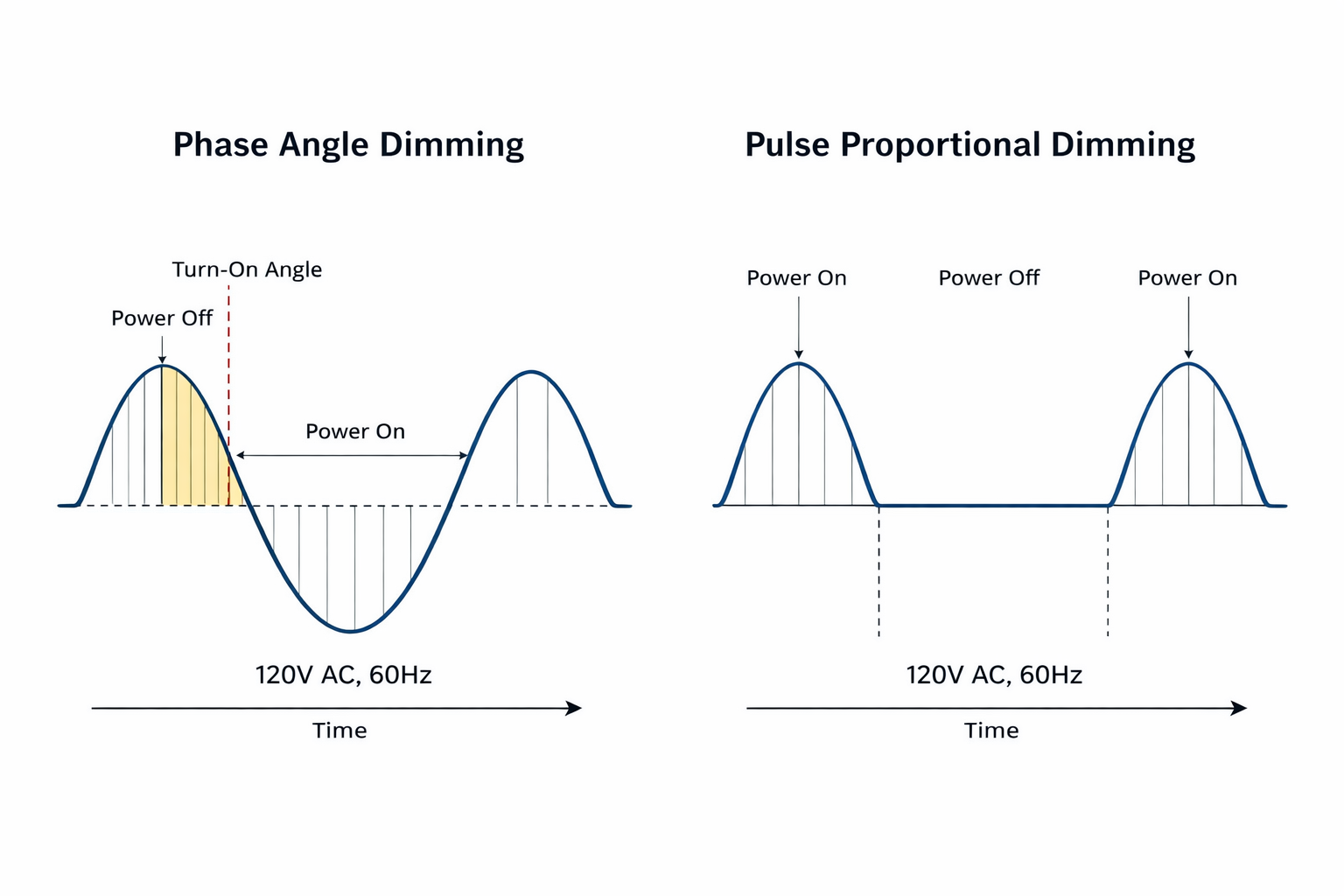
The reptile thermostat market gets this. There are already some products that support proper dimming modes, but they're all closed boxes designed to be standalone thermostats. They're also absurdly expensive for what amounts to a temperature controller with questionable build quality. We didn't want a thermostat. We wanted the AC control layer, something our sensor board could talk to directly. Something with an API.
What we found
The obvious first stop was IoT relay boards. Digital Loggers makes a popular one. One control signal, 4 outlets. But it's binary. Two outlets off OR one outlet on. Switch between those two states, with 1 extra outlet that is always on. No dimming. And it's one channel, which means you can't independently control the outlets.
We bought relay boards from Amazon to prototype with too. The cheap 4-channel and 8-channel modules that you see everywhere. They probably work fine for DC loads, but plugging them into mains voltage felt sketchy. Like they're fine for bench projects. But there's a gap between "it works" and "I'd leave this plugged into mains in my house while I'm asleep." Cheap parts. No real isolation. Obviously no certification.
And even if we trusted them, we'd still have to wire them up :)
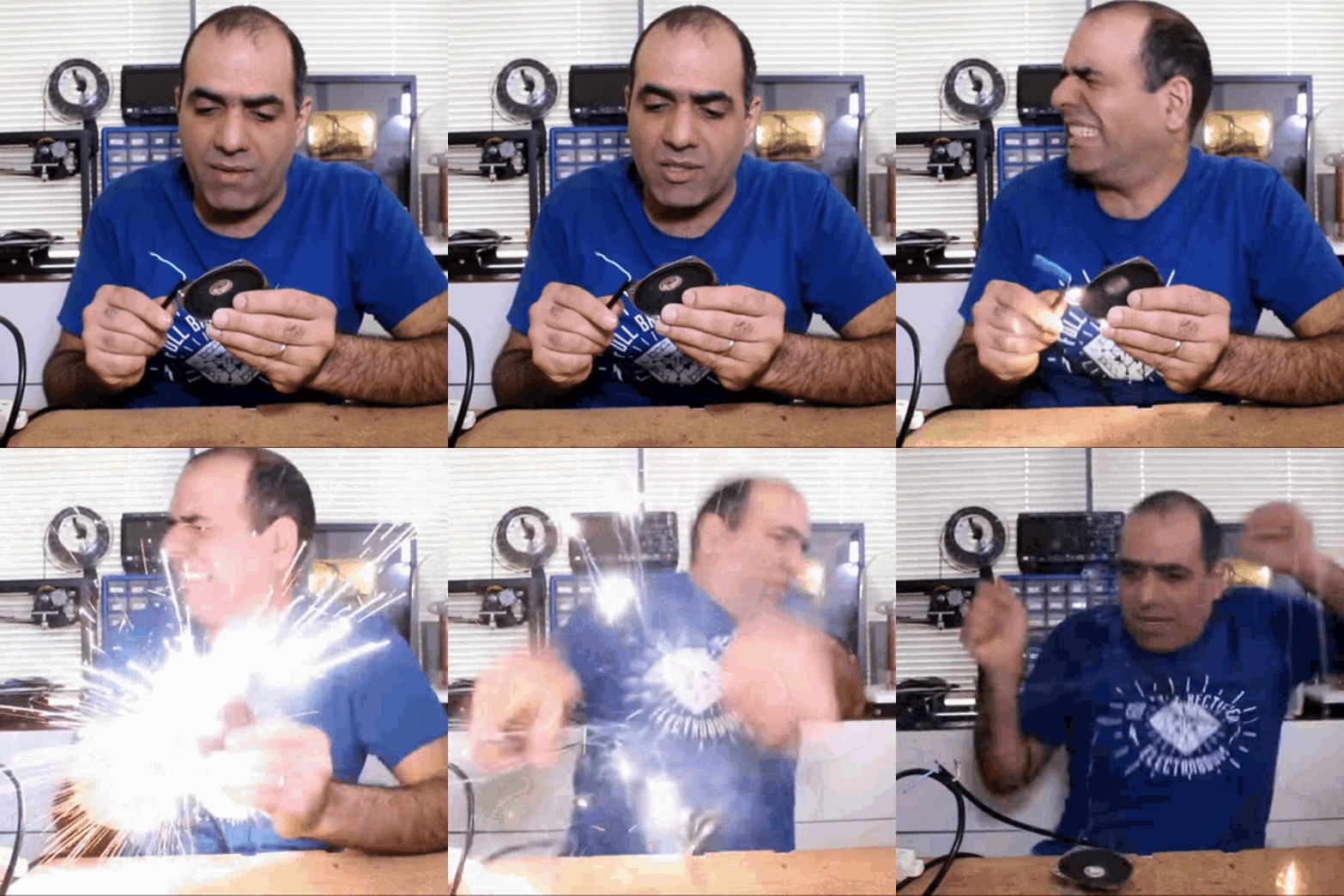
There's also the question of what you're actually switching. Most relay boards are rated for resistive loads: heaters, incandescent bulbs, etc. But the moment you plug in a fan or a pump, you're dealing with an inductive load. When you cut power to an inductor, the collapsing magnetic field generates voltage spikes that arc across relay contacts, wearing them out fast. And it's not something the cheap boards bother with or are typically rated for.
We looked at industrial solutions. Ethernet relay boards with HTTP APIs. Power strips with REST interfaces, Modbus, MQTT. These are legitimate products with proper certifications. They're also $500+ per unit, designed for server rooms and AV installations, and in our case, beyond being prohibitively expensive, they don't dim. They switch. Same limitation as everything else.
The smart home market was the worst of all. Every "smart power strip" we tested was some variation of Tuya firmware phoning home to a cloud service. Even the ones that technically have local APIs bury them under layers of authentication that require cloud accounts to set up. Most lock you into the Alexa or Google ecosystem, or force you to use their proprietary app. One product returned XML wrapped in JSON for reasons we still don't understand.
We spent a few weeks looking for something that met five requirements:
- Individual outlet control (4+ outlets)
- UART or HTTP Local API (no cloud, no app)
- Dimming support (phase-angle and pulse-proportional)
- Surge protection
- Safety certification (UL/ETL)
Nothing existed.
Building it ourselves
At this point we had to build the power controller ourselves.
The vivarium was the thing we actually wanted to make. But we couldn't make it without solving the AC problem first. And the more we looked at it, the more it seemed like other people had this same problem and just... worked around it. Or gave up. Or built sketchy one-off solutions they'd never show anyone.
So we decided to build it properly. Which meant understanding what "properly" actually meant. Something we'd feel safe having in our own homes. With our families.
What we built
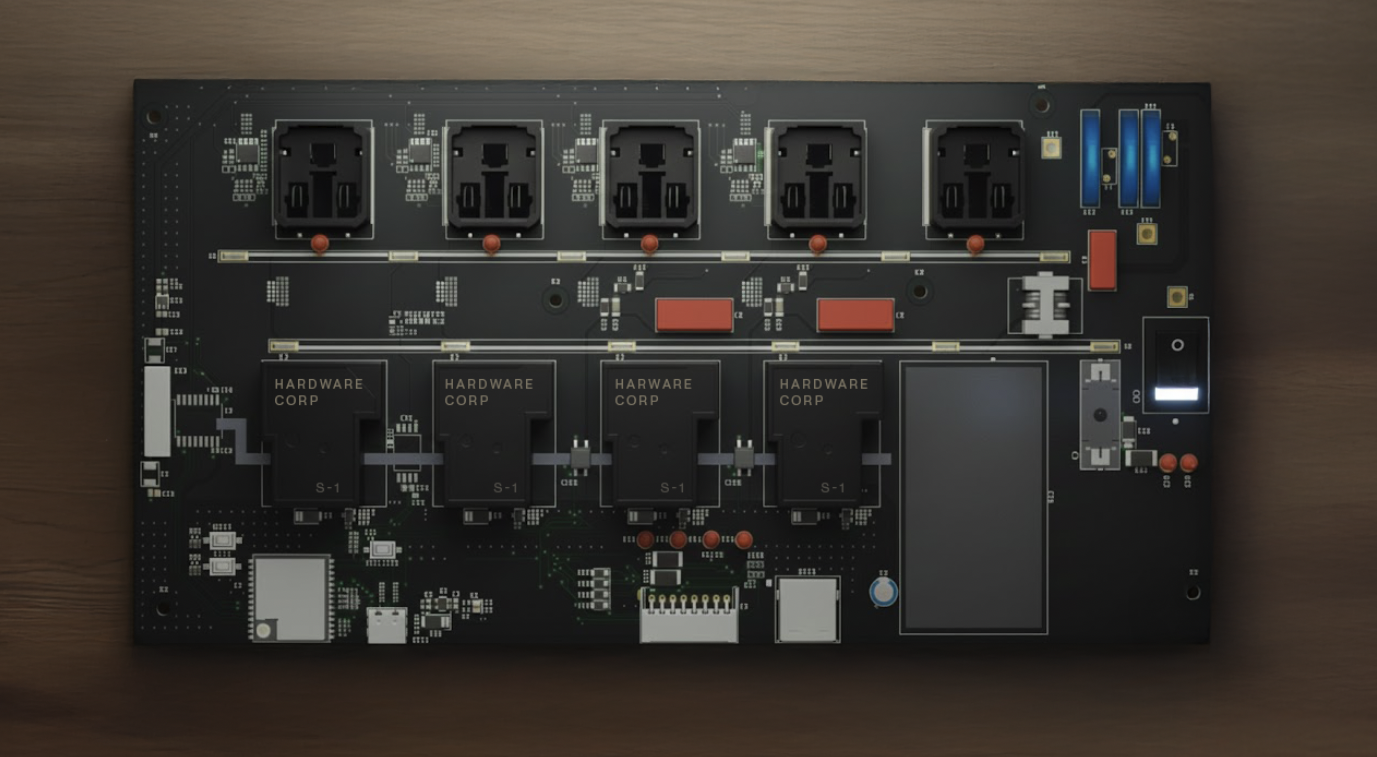
Open Outlet S-1 is a power strip with four individually controlled outlets, one always-on outlet, a UART interface, and an HTTP API. No cloud. No account creation. No app.
# Turn on outlet 1
curl -X POST http://openoutlet.local/api/outlets/1/on

# Set outlet 3 to 50% brightness (phase-angle dimming)
curl -X POST http://openoutlet.local/api/outlets/3/dim/50

# Get status
curl http://openoutlet.local/api/status
It supports both UART and HTTP because different projects have different constraints. Sometimes you want network control. Sometimes you just want to wire it to a microcontroller and send serial commands. Both do the same thing. It also includes simple IO inputs (3-48 VDC) for direct control without any code.
The outlet supports three modes: relay (on/off), phase-angle dimming, and pulse-proportional control. You configure the mode. Two are dimmable, two are just on and off, and 1 is always on.
Specs
- Input: 120V AC, 60Hz
- Output: 5 × NEMA 5-15R outlets
- Max load: 15A
- Control: UART + HTTP REST API + IO inputs (3-48V DC)
- Dimming: Phase-angle (for resistive/incandescent loads) and pulse-proportional (for thermal mass loads)
- Inductive Loads: Up to 2.4HP
- Protection: Surge protection, ETL certified
Why we're selling it
The market for "power strips with APIs" is weird. At the low end you have these kind of hobbyist relay boards. At the high end you have industrial automation gear that cost several hundred dollars per unit. In the middle, where you just want a safe power strip that responds to IO pins/HTTP requests and can dim a heat lamp, there's basically nothing.
Maybe that gap exists because the market is small. Maybe it exists because the certification costs scare people off. Maybe it exists because everyone who needs this either builds their own janky solution or gives up.
We don't know if there's a real business here. What we know is that we needed this thing, we built it, and we thought it was worth finding out if other people needed it too.
— Hamza, Zain, and Josh